 |
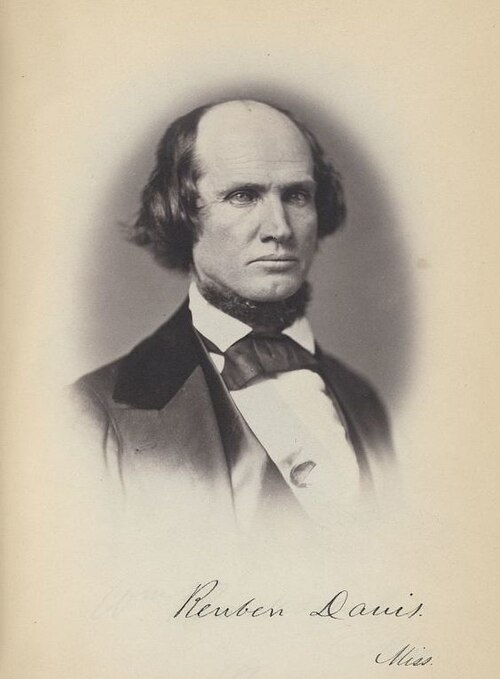
| Congressman
Reuben Davis, of Mississippi |
Speech of
Congressman Reuben Davis, of Mississippi, on the Speaker of the House
Controversy,
and
A speech by Congressman Reuben Davis, of
Mississippi
Dec. 8, 1859
| It
has never been uncommon for Members of Congress to "revise" their
formal speeches. Thus, a published form will differ from what the
Congressional Globe prints,
and sometimes there will be two versions in the Globe: the original, as given on
the floor; and then the revision, typically published in an Appendix to
the Globe.
The differences between the two versions of this speech by Reuben Davis
(1813--1890)
are massive. The original takes up less than a single page of the Globe,
filling perhaps two full columns. The revised version takes up
three full pages plus two additional columns! Congressman Davis
(no relation to Mississippi's Senator Jefferson Davis) makes it very
clear here that he does not want to see William H. Seward become
President in 1860, nor does he want a "Black Rebublican" to be Speaker
of House in 1859. And he threatens, at the end, armed resistence
("we of
the South will tear this Constitution in pieces, and look to our
guns for
justice") to the
election of any Republican to the Presidency in 1860. During the
Civil War, Davis held a number of positions in command of state troops,
but saw no action. |
|
Mr. DAVIS, of Mississippi, said: Mr. CLERK: It was said by
the gentleman from Illinois, a moment since, that he understood I was
anxious to address the House to-day. I am not anxious. I have been here
for several days without consuming a moment of your time. I was
ready to vote the first hour I entered this Hall, and am now ready and
willing; and if I could be assured no more speeches would be made by
other members, I would yield the floor, as I am as anxious as any one
to have an organization, and quite as unwilling, unnecessarily, to
consume our time in these discussions. In my remarks to-day, invective
is no part of my purpose. I have nothing severe to utter against any
member here. I speak only for the purpose of expressing to the House my
views in reference to the present condition of this vast country , and
to point the attention of members here to the dangers which pend over
us. I arise only to array, if possible, the Representatives of the
nation here, in support of measures of harmony, and to induce others to
come back to the support of the Government in its spirit and intent, as
established by our revolutionary forefathers. I think the Government is
worth saving. I am no disunionist, per
se. It is the last desire of my heart that this union of States
shall ever be rent asunder. I was, by a revolutionary sire, taught to
love it from my cradle, and I now admire it for its present greatness,
for its vast achievements, and for its past glories; and I am willing
to-day to make as many and as large sacrifices for it as any man in
this House or within the limits of our vast and great country. But, in
my judgment, there are evils which may spring from it greater than any
advantages which the Union now affords, and when those evils shall
come, if they ever do, with all my admiration for it I will aid in
rending it asunder.
Yesterday, the members of
the Democratic party from the South were denounced by the distinguished
gentleman from Tennessee [Mr. NELSON] as being fire-caters and
disunionists. This is the language used to us in 1851, and then, as
now, unjustly. The contest in that year, between the two parties South,
grew out of measures settled by the compromise of 1850 in such manner
as to inflict upon the southern States great injustice. That, taken in
connection with a long line of former grievances, induced us to
determine, by State action, to demand of the free States guarantees for
future equality and justice. We believed the features of the compromise
foreshadowed the coming storm, which is now breaking with such terrible
fury upon the southern States of this Union. We did not propose to go
out of the Union; that was not the position of the South then. The
party of the gentleman from Tennessee did then make the charge of
disunion against us; but it was a party movement for party success and
triumph. Many of our opponents then, now regret their opposition. Sir,
our object was not disunion; we only proposed that the southern States
should meet in convention and counsel together; and if, in their
judgment, the northern States were aggressing upon us, we would demand
further constitutional guarantees that our equality and rights, under
the compact of our fathers, should no further be violated. To this
extent only did our party go in 1851. We all denied the charge of
disunion then made against us. The State-rights party did then say
that, when this demand was made by the southern States, if it was not
heeded by the northern States, they would regard the refusal as
evidence of their determination to overthrow our institutions and
deprive us of our equality in the Union; and in that event, rather than
remain in the Union as inferiors, trampled upon by the despotic will of
haughty usurpers, we would secede even at the peril of ruinous war. And
I say here to the gentleman, if the whole South had been united in that
demand, we would have secured concessions which would have given
concord to our people and harmony to our country; and to-day,
asperities of sectional feeling and section animosity would not be now
disturbing our deliberations.
The honorable gentleman from Tennessee also holds the Democratic party responsible for the disturbed condition of the country. I suppose his object in this was to prejudice us in the estimation of the nation. As a member of that party, I make no denial to the charge. I am willing to take the responsibility thereof; but has it occurred to him why this is so? We have been the granite shore against which the angry waves of abolitionism have beat in vain, which has put limits to its advance, and stayed its aggressions; we have stood upon the Constitution of our country, and resisted aggression. For this the thunders of their denunciation, from rostrum and pulpit, have been hurled against us; to that extent the Democratic party may be responsible; to that extent we may be obnoxious to the charge of the gentleman; and I am astonished it has not occurred to him that patriotism demands that he should have sinned with us, if it be sinning. He knows the Abolitionists of the free States desire to overrun us; and have interfered with our domestic institutions within the limits of the States. I vindicate, then, the Democratic party against the charge, but proudly assume the lofty responsibility. That party is the barrier over which the Abolitionists must break before they can invade directly our domestic institutions, or deprive us of our just equality under the Constitution of our common country. The position of our party is, that the spirit and letter of the Constitution shall be the rule of the action of the Government; that the integrity of the Government be maintained, and the Union be continued forever; and that every State in the Union be permitted to enjoy its full equality in rights and in privileges, under the compact of our fathers; and if this is not allowed, then the Union is a failure, and should be dissolved. We blush not to acknowledge this as our lofty position, and we sneer at the criticism of opponents. Now, Mr. Clerk, I wish to make to the honorable gentleman from Tennessee [Mr. NELSON] the most distinct disavowal of any intention to charge him or his party with having any sympathy with WILLIAM H. SEWARD and the Black Republican party. I cannot believe that any man has yet been born upon the soil of Tennessee, or breathes the air wafted over that gallant State, who could for a moment cooperate with WILLIAM H. SEWARD in his measures of treason, rapine, and murder, against the South. But I do wish to remind him and his party that WILLIAM H. SEWARD has said the Democratic party must be put down, because it is now the only support of slavery. Do you not know he has said the only thing which now gives protection and security to the institution of slavery, and averts from the southern States an invading horde of murderous fanatics, is the national Democratic party? Do you not know be has said, every party which has vindicated the rights of the South to her institution has been annihilated by the Abolitionists? Do you not know he has said, the only thing remaining to be done, to enable him to propagate effectually and successfully his doctrines of emancipation, is the destruction of the Democratic party? He admits it is national, and the only national party in the country, and therefore stands in his way to triumph. I tell you, then, if the Black Republicans shall be victors in the battle they are now fighting with the northern wing of our party, nothing national will remain, and the Constitution of our country must be destroyed in the sectional conflict for existence. This being the case, looking to the great object the Republican party has in view, are you not indirectly---ah, directly, I may say, although not intentionally---aiding that party to effect its object, by your present position? Mr. NELSON. With the permission of my friend from Mississippi, I beg leave to say, once for all, that, so far as I am personally concerned, I detest the doctrines avowed by WILLIAM H. SEWARD. Mr. DAVIS, of Mississippi. I know that; and therefore desire fairly to bring to your attention how your position now may aid him in breaking down the Democratic party, which he so anxiously desires to destroy for the sin of staying the ruin he would bring upon us. I believe the gentleman and his party are as patriotic as I am. I believe that he and they would make as many sacrifices for the interests and rights of the South as I would; and therefore it is I [who] appeal to them to come to-day, throwing over the memory of our past party conflicts the mantle of oblivion, hushing their prejudices for us in slumbers, and array themselves under the constitutional banner of the national Democracy, and fight with us as allies, until we shall have vanquished forever from this Eden of liberty, this land of the free, and this home of the brave, this foul and fiendish spirit of abolitionism, which, if allowed to live, must bring ruin upon us all alike. Holding the Democratic party to be the only national party of the country, embodying the only element of power capable of resisting successfully the further advance of abolitionism, in my judgment, it is the duty of conservative men everywhere—come from whatever quarter of the Union they may, called by whatever name—to come forward, sustain us and aid us in the vindication of the country against the wild and wicked schemes of treason and revolution of the Republicans. I do not address myself to the Americans only, but to conservative men of all names. The prosperity and safety of the Union demand that the wild storm of fierce and angry passion now reveling through the southern States, awakened into being by the Harper’s Ferry affair, and now to be augmented into a hurricane by the intelligence that sixty-three members upon this floor have signed the insurrectionary recommendations contained in the Helper book should be allayed, that some evidence should be given which will enable the South to sleep in quiet until the next presidential election, which we have determined to regard as decisive of the future. It is the duty of all, this day, to declare unceasing and relentless war against the designs of the Black Republicans, and thus quiet existing agitation. Come, let us pledge ourselves to maintain the Constitution’s equality and justice, which has held us together thus far. In this there is nothing unmanly, nothing undignified,or anything worthy of censure. On the contrary, it is worthy of laudation. I remember, when the allied armies of Europe had driven Napoleon back to Paris from his bloody fields of conquest in Germany, and caused him to abdicate, and had banished him to Elba, and had assembled in Vienna to reconstruct the nations upon the continent, and had, in the performance of this delicate duty, quarreled among themselves, and were arraying their armies against each other to make the decision with the sword, intelligence reached them that Napoleon had escaped from his banishment and was again [in] France—discord was hushed, and instantly all elements were united against their common enemy. Cannot conservative men, although they may differ upon other subjects, act with the wisdom and magnanimity of the great nations of Europe? Can they not act together until they shall put down the common enemy of our great and glorious country—the enemy to equal rights and free institutions, and of the Constitution of the Union? Come, gentlemen, let us unite our shields over the heart of the Constitution, and inscribe on our banner State rights and strict construction of the Constitution, and maintain it or perish together. But gentlemen say they see no cause of alarm. I would there were no cause. I think I shall show hereafter great cause for apprehension; and that prudence demands action—instant, decisive, and effective. Before I proceed further with my remarks, I must ask one question of this House and the country. It is this: What is the cause of the want of harmony between the northern and southern States? Which section is responsible for this discord? A more loyal people, I assert, to-day, than the people of the South have always been, never lived in any country. We have paid our part of your taxes without complaint, without murmuring. We have fought your battles in every war, and with as much heroism and gallantly as the people of the North. We have shown ourselves always as ready to vindicate the rights of the northern people when aggressed upon either land or sea, as they have done themselves, and on many occasions we have stimulated them to duty. There is not a single duty which a people owe to their Government which we have not discharged willingly, which we have not performed with alacrity and fidelity. We have never demanded of the Government a single right to which we were not clearly entitled under the constitutional compact with our fathers; and I challenge gentlemen on the other side of this House to put their finger upon a single demand we have ever made to which we were not entitled, not only by the spirit but the very letter of the Constitution. On the other hand, I declare, that the Representatives of the South have never by their votes withheld from the North a single act of justice. Then, as we have been loyal to the Government, as we have discharged every duty we owe the Government, as we have denied nothing to the free States which was theirs of right, as we have done you full justice in everything, as we have by our agricultural industry contributed to lay the foundation of your great national and commercial wealth, as we have done all this, why is it that we this day have no peace and are now compelled to look for safety against your aggressions out of the Union? But you tell us we have no cause of complaint. I will show otherwise: In March, 1858, WILLAM H. SEWARD uttered, upon the floor of the United States Senate, this language:\ “The question of slavery in the Federal Territories, which are the nurseries of future States, indedent of its moral and humane elements, involves a dynastical struggle of two antagonistical systems, the labor of slaves and the labor of freemen, for mastery in the Federal Union Now, mark the proposition: It is that there exist in the States which make our Federal Union two distinct systems of labor in positive antagonism, resulting in an “irrepressible conflict” which admits of no reconciliation or compromise. The one system is that of the southern States—the other that of the free States. This is an important announcement, and, if true, must result in the overthrow of one or the other, and that after long-protracted and bloody war. In connection with this assertion, the same gentleman, at Rochester, in the course of the next summer, declared that this antagonism could only end by the emancipation of slavery in the southern States or the introduction of slavery into the free States. I shall not stop, Mr. Clerk, to discuss the correctness of this position. It is enough for my purpose that it is so regarded by the Black Republican party in the non-slaveholding States, and that they are now acting upon it, and thereby forcing us to assume the attitude of defense, and are embittering the fountain of peace and concord, and forever alienating the affections of the people of the two sections of the Union. It is nothing less than a solemn declaration of war, and we must prepare for it. Suppose, Mr. Clerk, we were to receive in this House, to-day, a proclamation from Great Britain, in which it was stated that an antagonism existed in the form and principles of their Government and ours, and that both must become despotic or both free, and that the antagonism could not be arrested or compromised until the one or the other was overthrown and subjugated. What, sir, do you think, would be our indignation, and how would we act in such an emergency? Millions would be appropriated for defense, and the nation would resound with the cry, To arms! Do you think, sir, that we of the South are less sensitive to this threat made against us, or less willing to defend the land of our nativity—our sunny valleys, in which sleep the remains of our fathers—than the whole nation would be in the case I have supposed? If you do, I assure you, sir, you are mistaken in the character of our people, in their lofty patriotism, in their manly courage, in their recklessness of death, in their hatred of tyranny. We will resist. We are the descendants of a revolutionary ancestry, who spilt their blood like water, and spent their money without regret, to strike off the shackles of British injustice and legislative tyranny; and we will sacrifice our lives, burn our houses, and convert our sunny South—now beautiful as a garden of flowers, rich in soil, and yielding to agricultural industry the abundance which has given to the North and the world its present commercial and national prosperity—into a wilderness waste. We will do it, sir, at the hazard of bringing upon the world bankruptcy and ruin, famine and pestilence, lamentation and mourning.Mr. Clerk, it is declared that the labor systems of the two sections of the Union are incompatible, and that one or the other must go down. War is declared against us. Sir, may I not ask national and conservative men, whether Americans or anti-Lecomptonists, whether Whigs or philosophers, to unite with us in the organization of this House as one means of arresting this war of interest, until the sober second thought of the people can have time to recover and blot it out forever? It is time we were harmonizing. It is time we were cooperating. It is time the constitutional and national men of the nation were rallying under our banner, given as it is to the whole country and dedicated to nationality. Americans, I appeal to you by the love you have for your fair sunny South. You have no party organization which is national. You can cooperate with no party in the North outside of the Democratic organization. You see us struggle for existence—an existence necessary to avert the destiny which hangs over us. We ask you, to-day, to rally with us und aid us in putting this rebellious organization, whose advance columns have already polluted our soil with their tread of treason and shed southern blood upon southern soil; we only ask you to aid us in our efforts to avert from the country the calamity of a Black Republican Speaker of this House; retain your party names if you will—your distinctive organization. This is a fight involving the destiny of the world and the future of mankind. When we have settled this contest we can again divide and carry on our contest as to what is best to be done to promote the general welfare and individual happiness of our people. This will be the highest evidence of patriotism and devotion to your country’s good, which you can give, and for it your constituents at home will thank you, and the Democracy throughout the Union will thank you, and your wires and children will thank you, and God will bless yon, and from millions of voices you will hear the songs of rejoicing and praise. Mr. Clerk, this interference with our rights is in direct violation of the compact of our fathers, and is positively in defiance of the very letter of the Constitution. Our fathers, at the close of the war of independence, found thirteen States here; each was a perfect sovereignty, and possessed unlimited powers of legislation, and were fully adequate to the duty of passing all laws necessary for her people—to make treaties, declare war, and do everything appertaining to government. They saw, however, the complication which would arise from commercial intercourse with each other and with foreign nations, and they, therefore, thought it better to create a General Government, with jurisdiction over the subject of war, foreign commerce, and inter-State intercourse. Its jurisisdiction, therefore, embraces subjects strictly national, while all that appertains to individuality falls within the jurisdiction of the State governments. But I have not time to elaborate this branch of my subject, and I will pass on. Mr. Clerk, many of the gentlemen who recommended the Helper book excuse themselves now by the plea of ignorance. I wish to know whether they will repudiate the hideous doctrines contained in this speech of SEWARD’s. That little, smallest one of the WASHBURN family, from Maine, I believe, uttered about the same language, last winter, upon this floor. Mr. SEWARD says: “Each one of the existing States has already staked not only its internal welfare but its influence in the councils of the nation in the decision of this contest. Each one has already staked its internal harmony on the decision of the question. Here he announces that the internal harmony of each of the States of the Union is staked on the issue. What is the issue; nothing short of the destruction of slavery within the limits of the States. This is war waged against us in violation of the Constitution, and you of the Republican party know it. Do you disavow this. It is more offensive than the Helper book—you do not repudiate it, but indorse it. You have already carried that war into our borders by invasion. You have sent armed men into the State of Virginia, murdering our people, advising our slaves to take arms from you for the most despicable of all purposes, the butchery of helpless women and innocent children. For it I invoke the vengeance of Heaven upon you. While the invasion was preparing SEWARD made this announcement, and foretold this invasion, and but nine months since sixty-three of you indorsed and recommended the Helper book as a means of encouraging John Brown in his fiendish and murderous plots. You even go so far as to say you will neither have political, social, or religious intercourse with us. Are these things not calculated to inflame the minds of a gallant and high-souled people? Is there no cause in all this for disunion, and the dissevering the ties that bind these States together? If we were to hold this chalice to your lips would you not be excited? I question whether your cold philosophy would not kindle to a flame, which would consume yourselves if not us.But the struggle between these two systems “is not to be arrested or reconciled by compromises or otherwise.” What, then, is to be its end? Compromises cannot terminate, nor can it “otherwise” be ended save by the extermination of the one system or the other. I confess, sir, this though it is as bold as it is impudent, as insulting as it is treasonable, may be as true as the position is founded in false philosophy. Well, sir, it is an announcement we cannot misunderstand, and will not disregard. We are arming to meet it. In this are we acting improperly or unwisely? Would the people of the free States not do the same thing under similar circumstances? We see and feel that unless we now arrest this conflict, and extinguish the fires of this relentless war declared against us, even in blood if necessary, ere long we will be compelled to stand by, powerless to avenge, and look upon the flame as it arises from our burning homes, and witness the gleaming blade as it strikes to the hearts, our wives and our children and ourselves. We are excited upon this subject, and justly so, and we are arming for the worst. But we are to have no
more compromises; you will grant us none. Thank God, there is nothing
left us which can be surrendered even to compromise. We have already
yielded you everything which compromise can reach, and that you know.
We have yielded that for which your early struggles were—the balance of
power; and therefore it is you now [who] use the language of defiance
toward us, and tell us you intend our overthrow. There are two things
which have never been yielded—our homes and our honor; and these things
we will never yield. You may, by the brute force of numbers, rob us of
our homes, but our honor will be vindicated by the title we give you
written in our blood. Sir, the gentleman from Pensylvania, [Mr. STEVENS,]
on the day before yesterday, had the insolence to insiniuate that the
South had surrendered her honor in the compromises already made. For
the sake of peace we have surrendered many of our political rights; but
we will surrender no more. We will not be driven one inch beyond where
we now stand; we will be butchered first, and only invite those who
have raised the storm to lead its madened columns, that we may
encounter them in the death-grasp, and catch the first wall of their
damned spirits as they enter the regions of [woe]. But, Mr. Clerk, I
will proceed with the examination of this speech of WILLAM
H. SEWARD, because it is the platform of the Republican
party. It was so announced last winter upon this floor, by Mr.
Giddings, in his valedictory, with the concurrence of the whole
Republican party. He advised his friends to present SEWARD
and his platform in 1860. He admitted they might be defeated in that
contest, but gave it as his opinion that it would be their last defeat.
He told them to present the naked question of emancipation of our
slaves, and I heard no dissenting voice. The advice did receive an
approving sanction.
“Does this fact mean nothing? All parties in this country that have tolerated the extension of slavery, except one, have perished for that error already. That last one—the Democratic party—is hurrying on, irretrievably, toward the same fate.” Does this language mean nothing? Do gentlemen on the other side of the House indorse it? They certainly have not repudiated it. You have already arrested the extension of slavery. SEWARD says:“All parties in this country that have tolerated the extension of slavery, except one, have perished for that error already.” Does not this language declare there is but one issue before the American people, and upon that issue the election for President, in 1860, is to be put? And does that issue not embrace both the extension and existence of slavery? He says so; and no man of the party has taken issue with him upon it. Who are the parties to it? SEWARD says it is the Democratic party on the one side, and the Black Republican on the other; and that the Democratic party must be hurried on to its ruin. Administration after Administration, we are triumphantly told, has fallen beneath the fierce war of the Abolitionists; and they tell us the only party now national is the Democratic party, and it is that which arrests them in their march to conquest and victory and that it must and shall be destroyed.These announcement have, and are, extinguishing in the southern heart all sympathy with the great mass of the northern population, and are substituting seeds which must produce fruits of bitter revenge. I, to-day, have more affection for an Englishman than I have for a Black Republican. The latter I regard as wishing to oppress me and curse me with injustice and wrong, while the former engages with me in honest and just commercial intercourse. Do you believe, gentlemen, that a people between whom there exists a feeling amounting almost to hatred can long live at peace? “All Administrations which have avowed this policy have gone down dishonored for that cause, except the present one.” The honorable member from Tennessee [Mr. NELSON] eulogized Mr. Fillmore for having done much for southern rights and southern institutions. Admit it; but has he, too, not fallen for that very cause? Fallen because he dare do his duty to his oath and the Constitution of his country? Now, sir, the member from Tennessee and his party have an opportunity to avenge the fall of their hero, and do good service to their country by striking—and in our ranks, and with us—the monster fiend abolitionism. Will they do it? or will they stand indifferent spectators in the battle with the Democracy, and see us fall, and then render quietly the dominion of the country to the usurper? Ay, sir, the same arch traitor tells us that—“A pit deeper and darker stilll is opening to receive this Administration, because it sins more deeply than its predecessors.” The sin of President Buchanan, for which he is to be immolated to the black god of abolitionism is, he has too faithfully discharged his duty to the South. Are we, then, to stand by and see our constitutional friends of the North, lending us a helping hand in the hour of danger, trampled in the dust? We ought not. Are we to allow them to be defeated by SEWARD and his revolutionary followers? We should not. I have said revolutionary followers. I have said it not idly. I have the proofs for the charge—proofs which will show SEWARD must have known of John Brown's intention to invade Virginia, for which invasion John Brown has met the gallows, and for which knowledge SEWARD deserves it. [Applause.]“There is a meaning in all these facts, which it becomes us to study well. The nation has advanced another stage; it has reached the point where intervention by the Government for slavery and slave States will no longer be tolerated” What is that stage to which the Union has advanced? It is this: at the time of the formation of the Government there were twelve slave States and but one free State, and we retained the majority until within a few years past; now there are seventeen free States, and only fifteen slave, so the balance of power has passed from the slave to the free States. In this condition of things, we are informed that the free States are organizing to seize the Government as the representative of their system of labor, and it is to be used by them as the instrument for the destruction of our system, and while in their possession, will no longer be allowed to intervene for the protection of slavery or the slave States. Our property is to be left exposed to the invasion of the robber and the lawless; and even if the slave shall rebel against his master, we are not to expect any support from the Government. I have always understood that the object and purpose of government was protection of property, and when the protection of property ceased, the citizen was released from his allegiance to that government, and with this recognition of the duties of government, we of the slave States would now be satisfied; but we are told that we shall not have protection, and that we shall still observe allegiance. This will convert the Government into a despotism of the most detestable character, and will cause us to resist.But again, we are informed that the State itself shall not be protected in its sovereignty. Now, Mr. Clerk, this Government is the Government of the slave States us much so as that of the free. It was made by a compact between the slave and free States, and I must ask gentlemen of the opposition what right they have to seize it to our exclusion, and whether the act will not be a revolution and constitute those engaged in it rebels. This announcement is a declaration to the nations of the whole earth that they may invade us in our sovereignty and our property with impunity. John Brown, and a thousand other John Browns, may invade us and the Government will remain neutral—there will be no Army, no Navy, sent to resist any invasion; but we are to be left to the tender mercies of our enemies. Yet we are told we have no right to complain; that we have no right to suppose we will not be protected in our property, and should submit peaceably to the Goverment passing into the hands of the Black Republicans. We may do it, but I do not believe we will. Ought we not, then, in frankness to tell our northern compatriots that if we are not to be protected in the Union, we will protect ourselves out of it, even at the hazard of deluging this vast country in a sea of blood? SEWARD says: “Free labor has at last apprehended its rights, its interest, its power, and its destiny, and is organizing itself to assume the Government of the Republic.” So we are informed there is a conflict between the system of labor in the free and slave States, and free labor is organizing to take possession of the Government, and when this event happens, you inform us we shall neither be protected in our civil or political rights. You even go so far in your meanness as to tell us you intend, by the power of the Government, to force us to submit to your tyranny, despotism, oppression, robberies, and wrong. That is the announcement you make to us. If you want this Government, and wish to get rid of us, say so, and I will take you by the hand on that [applause in the galleries] and bid you a joyful adieu, and will promise to let you alone, but you must let us alone. We have always let you alone in the Union, and you must let us alone; in other words, while we are together let us stand by the contract of our forefathers—men a great deal better, perhaps, than those occupying seats on either side of this House. Again, SEWARD says: “We will henceforth meet you boldly and resolutely here on the floor of the Senate, in the Territories or out of them, wherever you may go to extend slavery. It has driven you back in California and in Kansas; it will Invade you soon in Delaware, Maryland, Virginia, Missouri, and Texas.” Ah! “it will invade you soon in Maryland and Virginia.” And, as foretold, Virginia has been invaded; invaded with pikes, with lances, with rifles; yes, with Sharpe’s rifles. Your murderers have already come within the limits of our States, as announced by the traitor SEWARD, in the speech from which I have taken this extract. Did he know of Brown’s intention to make this invasion at the time the speech was made, and was it Brown’s invasion to which he had reference? Forbes says so; certain it is, the invasion was then concocted. We have been invaded, and the facts of it show SEWARD to be a traitor and deserving the gallows. [Applause in the galleries.] Brown had organized his invasion at the time, and the constitution had been formed when the speech was made. Forbes was in the city of Washington then, and says he had a conversation with SEWARD in regard to the invasion. This testimony is sustained by that of Cook. SEWARD himself admits a conversation with Forbes about that time, and that he wanted money for an object which he refuses to disclose. It is due to justice that I should state that SEWARD denies that Forbes communicated to him the fact of the intended invasion; but, in my judgment, the weight of evidence is against him and in favor of Forbes. I believe Forbes. The word invasion has its own meaning. Brown had organized an invasion of Virginia, and SEWARD said Virginia would soon be invaded. He cannot escape complicity in the affair.Are these facts not startling, and should they not awaken apprehension in the mind of southern people? Is it not time we were arming for our defense? We are arming, and who will condemn us? SEWARD said “the invasion will be not merely harmless but beneficent, if we yield reasonably to its moderate and just demands.” What invasion does he refer to, unless it is Brown’s invasion? This language is exactly the same used by John Brown, who said, if Virginia had allowed him to take her negroes off peaceably, and without making any fuss about it, he would not have killed anybody. [Laughter.] Brown said he did not mean to kill anybody. SEWARD said the invasion would be harmless and beneficent to us, if we yielded to their just and moderate demands. But if we did not yield, what then? Why, Brown said he would kill our people, and butcher our women and children. SEWARD said: “Whether that consummation shall be allowed to take effect with needful and wise precautions against sudden change and disaster, or be hurried on by violence, is all that remains for you (the people of the South) to decide.” This is the very language of John Brown. Whether we will allow it to be done quietly or not, is the only question we are allowed to decide. We are allowed to decide, but however we decide makes no difference; the thing is to be done, at all hazards. Virginia has decided, and has hung the traitor Brown, and will hang the traitor SEWARD, if he is found in her borders. [Laughter.] Virginia has refused to yield, and you have attempted to force her. She met violence with violence—has hung your leader, Brown—has stood upon your borders with her armed men and defied you, but your clansmen appeared not to rescue the traitor.Mr. KILGORE. There was no disposition upon the part of anybody at the North to do it. Mr. DÁVIS, of Mississippi. I judge men by their acts and not by their declarations, as I judge you by this Helper book. Mr KILGORE. I desire to call the attention of the gentleman to the first author of this doctrine of an “irrepressible conflict.” Mr. DAVIS, of Mississippi. I cannot yield for that purpose now. Mr. KILGORE. I merely want to read a short extract—an editorial from a leading southern paper. If
there were no undiscovered
person in this affair, why did Brown so impressively urge his known
confederates not to betray their friends—and who are those friends not
to be
betrayed? The testimony, to my mind, shows SEWARD
to be one. Mr. Clerk, we are arming, but not against the Government; we are arming to put down rebellion against the Government; we are for the Government. The Black Republicans showed their organized rebellion when they presented Fremont as a sectional candidate for the Presidency, as a representative of their system of free labor in opposition to our system of slave labor; between which, they say, exists an irrepressible conflict. In that act you undertook to seize the Government for yourselves, in violation of the letter and spirit of the Constitution. Against that rebellion we intend to act; we mean to put it down even if we have to do it with the bayonet. And I call upon the American party to come forward and aid us in putting down this rebellion. I call upon the anti-Lecomptonites to come forward and aid us in putting down this rebellion. I call upon men of all parties, of all names, from whatever section of the country they come, to rally under the standard of the Constitution, under the old flag of our fathers—under the stars and stripes of our country—to aid in striking down rebellion that has grown up in our midst; some of the fruits of which we have already tasted. Understand, we do not mean to go out of the Union to whip you; we mean to whip you in the Union; we mean to crush out your rebellion in our midst, by the aid of patriotic men North, South, East, and West. That is what we intend. Do not call us disunionists, at all; that is not our policy. We know what you are after; you are money-loving people. [Laughter,] You think we will withdraw, and leave you in possession of this fine house. [Loud laughter.] We do not mean to do it. You think we will leave you the money now in the Treasury; you think you will get the Navy without cost, and the Army with arms in their hands. You are mistaken. We will use the Navy to put down your rebellion against the Government; we will use the Army to put it down; and we will hang the last one of you, unless you return to your duty. That is what we mean to do. [Roars of laughter.] The gentleman from Tennessee [Mr. NELSON] asks whether we intend to oppose the inauguraion of a Black Republican Speaker of this House? We will not, if they keep their hands off of us. But we hope to defeat such a dire calamity by the election of a national man, by the aid of the votes of his party; and we expect, by the same aid, to avert the still greater calamity, in 1860—the election of WILLIAM H. SEWARD. Mr.
Clerk, for our denunciation
of the Helper book, and those who recommend its treasonable doctrines,
we are
said to be unnecessarily sensitive. What! is it expected we will remain
silent,
while we see a treasonable organization for our destruction. It advises
insurrection. It advises the non-slaveholding white men of the South to
unite
with the negro to commit murder; to kill their neighbors; slaughter
women and
children; declares that the white man South is unworthy of political,
religious, or social association; and yet gentlemen think we should be
silent,
and these very men say we have no cause for excitement. Gentlemen on
the other
side of this House would have us regard them as men of straw until they
have
silently and surely trammeled us beyond escape. Sir, we shall listen no
longer
to their syren song of peace; we will judge them by their actions; and
we are
putting ourselves in readiness for the worst. The Black Republican
party have
from eight to ten million people in its ranks—fighting people—whose
ancestors
fought well in the war of the Revolution and in the war with Mexico. We
will
not regard them with contempt; but prepare to settle the great issues
involved
in our controversy with them by the arbitrament of the sword. Sir,
three or four of the
gentlemen who certified the book say they had not read it, and did not
understand its contents; the other sixty remain sullen and silent. None
have
disavowed its recommendation. So far as anything has been said in
exculpation,
it is a mere denial of knowledge of the contents. Gentlemen must
remember that
by the rules of the criminal law the culprit is not allowed to testify
in his
own behalf. If it were not so, the greatest criminal would escape
punishment.
By your silence you indorse the murderous and revolutionary doctrines
uttered
by Helper, and the still more treasonable doctrines contained in the
speech of
WILLIAM H. SEWARD
from which I have been extracting. And I charge to-day, in the face of
the
nation, that the book and speech were put forward at the very time they
were to
prepare the mind of the non-slave-holding white man South for the then
organized invasion of Virginia by John Brown. A
MEMBER suggested something
about taking the testimony of members, under oath, in regard to the
Helper
book. Mr.
DAVIS, of Mississippi. Oh, I
have so often had occasion to put men on their oaths, and have heard
them
testify falsely so often that I do not like to run the risk of inducing
men to
commit perjury. I have, therefore, no disposition to put them upon
their oaths. Mr.
Clerk, this book, this speech,
admonish the South of her doom. I will not detain the House by
referring to the
ten thousand accumulative evidences of the intention of the Black
Republican
party. SEWARD
is a representative
man, and
is the personation of the purposes of the party. The object is the
emancipation
of the slaves. Sir, I shall not detain you with a presentation of the
devastation which must follow it—the midnight burning, the cruel
tortures, atrocities
not to be named by civilized lips, or heard by civilized ears. I will
not call
up, before the imagination of members, the South in her dissolution,
lying, like
a mighty Leviathan, bleeding at every pore. I will only briefly
consider its
effects upon the general prosperity of the people of this country and
the world.
Emancipate our slaves, and you extinguish property now valued at about
four
billion dollars, the great productive wealth of the world. The labor
being
destroyed, our land in the South now worth at least $5,000,000,000, is
rendered
unproductive and idle during this generation, and for generations to
come. It
is this capital which lies at the foundation of our present national
and
individual prosperity. By it from four to five hundred million dollars
annually
added to the aggregate wealth of the nation. From it emanates our
national
prosperity, and it is that which gives individual prosperity. Destroy
it and
you produce national bankruptcy, and, of consequence, individual
bankruptcy. Destroy
it and you bring famine upon the land—laboring men will want
employment, and be
without the means of procuring support for themselves and families. Now,
sir, in view of these
calamities, national and individual, shall this Black Republican war
upon all
the interest of mankind be allowed to go on, or will the nation come to
the aid
of the national Democracy in putting down that party? The storm cloud
of
anarchy and blood and carnage and desolation has gathered darkly over
our
country. Its thunders and its lightnings come together, telling us of
its close
proximity. Come Americans, come conservatives, come patriots, let us
stand
together and bare our bosoms to its vengeance, and live with, or die
for, our
country, its freedom, and its laws. Gentlemen
of the Republican party,
I warn you. Present your sectional candidate for 1860; elect him as the
representative of your system of labor; take possession of the
Government as
the instrument of your power in this conflict of “irrepressible
conflict,” and
we of the South will tear this Constitution in pieces, and look to our
guns for
justice and right against aggression and wrong. Decide, then, the
destinies of
this great country. We are prepared for the decision. |
Back to Causes of the Civil War (Main page) Back to Congressional Speeches and Commentary Sources: Original: Congressional Globe, 36th Congress, 1st Session, p. 69. Revision: Congressional Globe, 36th Congress, 1st Session, Appendix, pp. 33--36. Date added to website: August 24, 2026 |